If I were to have one piece of advice to give to any parent, whether parenting a special needs child or not, it would be this: If you believe, deep in your heart, that what the experts are telling you is wrong, you need to listen to your heart.
When we first started looking into getting "medical" help for Nappy, our youngest daughter who happens to have arthrogryposis in all her limbs, we were steered in the wrong direction. I'm not blaming the doctor, at least not completely, and I'm not blaming the system. Neither is perfect, so in the end, you need to rely on the Holy Spirit to lead you down the right path.
About this time last year, a doctor who had only spent about 1/2 an hour looking at our daughter's arms and legs, made the decision that she would not be able to work a manual chair, and therefore, in order to "keep up" with her peers, needed a powerchair.
This doctor had no idea how this would impact our family.
First of all, it would mean changes to our van. If we wanted to cart the chair inside the van (which is what the salesman told us we would need to do), it would require purchasing a new vehicle. To transport our family of 7, would require a 15 seater van. Then the van would have to be customized to the lift/tie-ins. The estimates for that were anywhere from $15,000 to $65,000.
Then we learned that we could cart the 350lb wheelchair on the back of our van. A lift and installation would be anywhere from $1,500 to $10,000, depending upon who you talked to.
Then, there was the question of where she'd use this 350lb behemouth. It wouldn't work at home (not safe for the other children or toys), and she couldn't use it in a her Sunday School class or Co-op class -- again, for safety. She would need direct supervision, so she couldn't play with it outside unless I was with her. So, again, when would she use this chair? In therapuetic preschool. That would mean she, who only just joined a family one year ago, would be separated from us about 40+ hours a week (including transportation).
There was the cost of the chair, too, a $3000 co-pay (in addition to all the house and van work). So, this chair would have easily put our family anywhere from $5000 to $85,000 into debt.
What would that mean for our children? A total lifestyle change. Gone would be the days of relaxed homeschooling, time with mom and dad and opportunities to pursue their talents and interests. To pay off all the debt, I would have to go back to work full time, and, chances are, one of us would have to work a second job.
What would all that mean for their relationships? Certainly there would be resentment on that part of the other children -- they lost their beautiful childhoods because of a wheelchair. It would also teach Nappy that our family revolves around her needs. There's a great lesson.
Long term, what would that have meant for Nappy? Well, she would've never learned that she could work a manual chair. She would have never learned that she could climb into and out of a manual chair. She wouldn't be able to climb steps. She wouldn't have such a strong cardiovascular system. She would think that her enviornment must always be adapted to her, rather than she conquering her enviornment.
Now, if she wasn't able to work a manual chair this would all be different. For someone who's not able, a power chair is a liberating and beautiful thing, and I am so thankful that they have been invented!!! But the thing that was crazy is that no one checked to see if she could, it was just assumed she couldn't. The number one cardinal rule of working with the disabled was broken: NEVER ASSUME THAT A PERSON WITH A DISABLITY CAN'T DO SOMETHING!
So, now here we are a year later, and I have been proclaimed "right." Several days ago we ordered her a manual chair, under the direction of her doctor and a PT, that is fitted perfectly to maximize the workings of her unique body. Through out the entire wheelchair evaluation, the same people who, before, were telling me that I was in denial over her disabilities, that I was holding her back, that I was denying her the chance to keep up with other kids, were now telling me that I was "right." "This is the best situation for her." "Working the wheelchair will help with building the muscles that might help her to walk."
So, all of this is not to say that I'm really smart, or the doctors are really dumb (the vast majority of arthrogryposis patients cannot work a manual chair), but to just say that the Holy Spirit can convict and encourage you to see what the experts can't. Through this entire year, I had a weight on my back about the power chair. I knew it wasn't right for her. I knew it wasn't right for our family. It stunk to disagree with the experts. It really did. I had my ability to parent her questioned, and I'm sure, behind my back, my sanity questioned. But, I really believe God used his spirit to convict me that I needed to listen to Him and to do the unusual, and I'm so thankful that I did.
Ultimately, as parents, you're responsible for your child's development. The doctors and therapists can guide and direct, but they only get a small snapshot of your child's life. It's up to you to advocate, to follow God's lead, and to stand up for what you know your child needs.
In the end, our daughter has no clue of all the controversy that's surrounded her. She is, however, really happy that her new wheelchair will be purple with blue and silver accents and front wheels that light up.
Sunday, April 20, 2008
The Wheelchair Saga, An End in Sight!

Thursday, March 6, 2008
Am I Really Missing the Boat?
Yesterday was another "reality check" day. Once again, I was back at the hospital trying to figure out what we are supposed to be doing with our daughter whom all these people think is broken, and we don't think needs fixed.
This time was better than before. We were really not clicking with her last specialist, and at the advice of another doctor, switched to one of her partners. So, I have to say, this was so much better. First of all, I had all my questions answered. Second of all, she helped me develop a plan for how we will manage this case of arthrogryposis, including which limbs we should start with and in what order (right leg, left leg, right arm).
However, there were still things that bothered me. The first was a question asked by the nurse.
"Is she in preschool?"
At first I responded with a "no", but then I realized she goes to a preschool class at our home school co-op once a week (we've been sick for 3 straight weeks, so she's missed a lot lately).
The nurse looked befuddled at my "no."
"Well, actually, she goes to a preschool class once a week."
"Oh great. Then she does get some socialization."
UGGHHHH! Do people have any idea how tired home schoolers get hearing about "socialization." I thought about telling her that, actually, she's quite socialized for a 4 year old. She has 3 "good" friends, likes to make new friends, loves all her family and also wants to be with us rather than strangers. I thought about telling her how there have now been numerous studies done on the socialization of home schoolers (some even done by university education departments trying to prove that home schoolers are socially deficient) that have proven that, on average, home schoolers have better social skills than their public and private school counter parts. I thought about telling her that socialization is part of the reason I home school. I like having confident kids who understand how to make friends with people, don't instantly judge other kids by how they look or act, and also know how to stand up to peer pressure. But, instead, I just smiled.
Then, a resident came in and looked at our file.
"How long are you planning on home schooling?"
Am I wrong to think that this really isn't any of their business? I have worked with many other doctors at this particular hospital and none of them have ever questioned how my children were schooled. I didn't question it though, I just answered her.
"Until we think it's no longer in her best interest."
"So you're making her go with out an I.E.P. ?"
I wanted to say, "No, actually, her entire education is an I.E.P. (Individualized Education Plan), because she's my only preschooler right now. Her also home schooled 5 year old sister just finished up with all her kindergarten work and has started first grade -- obviously disadvantaged by homeschooling." But, again, I just smiled and said, "No, she doesn't have an I.E.P."
All the questions done, the real doctor came in. Everything was fine. Our daughter has multiple issues with all four limbs and this doctor was extremely helpful, but then she said something that really bugged me.
"She's really more limited than you realize. Maybe you're just used to her because you've been with her for the past year."
Is she really more limited than I realize? Is that really true? I mean, I live with the kid. I'm the one that has to drop everything and lift her onto the toilet when she needs to go. I'm the one that helps her put her shirt on and off. I'm the one that lifts her onto furniture when no step stool is available. I'm the one that waits while she climbs the steps, moves a step stool and climbs onto the furniture, and also waits while she wheels herself places.
Can a parent really not realize how physically limited their kid is?
In addition to that, how would things bode for her if I wasn't as positive about what she can do? Where would she be if I was approaching her from a standpoint of how limited she was?
I just really don't get it. She does everything that she is developmentally supposed to be able to do, with the exception of walking, putting herself on the toilet and taking off her shirt. How limited is a person if they can do all that's expected of them?
I realize that there are hurdles down the road. She'll have to learn how to put on her own braces (something that she isn't expected to do right now because of the design of the braces), how to put on a coat or jacket, how to cook, how to do more complicated chores and how to drive. But, am I missing something somehow? She has no problem manipulating small objects with her hands so handwriting and learning an instrument won't be a problem. She's shown an aptitude for letters, so I doubt reading will be a problem. She's great with numbers. Where's the problem? She's capable.
But, then again, I don't have an M.D., so maybe I'm just missing the point.
Thursday, December 13, 2007
Three Broken Glasses and Jelly on My Pants


Today I made a terrible mistake. I decided to leave my 5--year-old and 3-year-old at the table to finish lunch while I ran up stairs and quickly vacuumed the fine coating of dog hair that decorates every square inch of carpet in our house.
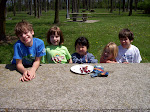
From these innocent pictures, you'd never believe the havoc these two can wreck. But, trust me. They know havoc wrecking like area plumbers know our main drain and laundry room (really well).
As I finished the last area of carpet, I heard my eight-year-old call to me.
"Mom, ***** broke a glass!"
Our 3-year-old has been known to break dishes. Since she can't bend her arms the easiest way for her to drink is with a straw. After some trial and error, we figured out that a coffee mug, because it's heavy and won't tip over, with a bendy straw works best. This worked well until the advent of her wheelchair, and then she got the idea that she wants to carry her dishes to the dishwasher. Normally, I would find that great, but since she's three, there's not enough lap for her to hold her dishes while she wheels.
She ends up wheeling and holding her dishes at the same time. The first problem this presents, of course, is if there is any food or drink left on her dishes. If there was at the table, that quickly changes as the food and drinks move from the plate and cups to the floor, wall, my clothes, the ceiling...
The other problem is that she will lose her grip on the dish as she's wheeling, and that's the worst time for her to lose her grip. The cup doesn't just fall, it gets launched across the room, as her arm (which is straight) is moving forward in a strong and swift movement at the precise moment that she loses her grip.
So, today, when our oldest daughter told me of the broken cup, I wasn't that surprised. Fortunately, coffee mugs usually don't shatter.
Unfortunately, that's not what happened.
I walked in the dining room to find our dining room tablecloth hanging off the table. There were broken dishes on the floor, salsa on the table, chairs, floor and wall. There was also salsa on our border collie. Both girls were crying. The dog was shaking and cowering.
It only took minutes to gather that the girls had been goofing around when they were supposed to be eating. The five-year-old had been pushing the three-year-old in her wheelchair (something she's not allowed to do, no less!) and the wheelchair got caught on the tablecloth, and pulled it and the dishes off the table.
Needless to say, I won't get mom-of-the year award for my reaction. Any person who has said that I'm a saint for adopting handicapped children would certainly revoke that honor if they saw me react to the salsa/milk/peanut butter and jelly/glass shards mess I was facing.
After my meltdown, I put both girls in separate rooms for time out. I was so angry I couldn't even look at them. My older three were great, and helped me get everything cleaned up. I think they were worried I might be sent off to an insane asylum if things didn't get fixed. No matter what their motivation, they were so helpful, but, sadly enough, my daughter cut her finger on a piece of glass (only adding to my anger toward the younger two!).
After it was all cleaned up(which took 45 minutes, and got my clothes nice and sticky), I sat down, and tried to focus my thoughts. I called the little girls together to talk to them. Still angry, I explained to them how their disobedience had caused me great pain, and it had hurt them. They like to pretend that under our table is a "Choo-choo train" and they had an assortment of toys that were ruined in the ordeal. We talked about sin and how our sin hurts other people and ourselves. We talked about forgiveness and how love stays the same no matter. It was a great heart-to-heart.
Then I asked them what they thought.
The three year old looked at me and said, "Look mom! We match! I got jelly on my shirt and you got it all over your pants!"
My five-year-old said, "Should I put shoes on now?" I had told her she had to wear shoes to protect her feet in case I missed any glass. "I'll get my pink boots. They'll protect my feet and they look great with my jeans."
I'm so glad this was a learning experience for us all!
Saturday, December 8, 2007
Einstein, Babies and Flashcards
I recently skimmed through a very interesting book entitled, "Einstein Didn't Use Flashcards" . The book was written by three women with doctorates in early childhood education and such related fields. The gist of the book is that parents should let their young children just play. Why in the world it would take a person with a PhD. to point out the obvious is beyond me. But I guess we've become such an expert based society that we can't even just let little kids play unless the experts tell us it's okay.
It reminds me of a visit I had with our middle daughter when we first brought her home from Kazakhstan. She was barely 2 years old and we had her assessed by almost every specialist known to man. During those evaluations we spent some time with an occupational therapist. Because our daughters hands and fingers are unusual in design, the therapist gave us home therapy.
Playing with legos
Playing with blocks
Playing with toys that have buttons
Playing in sand boxes
Playing with sewing cards
Playing with stacking cups
Playing with play dough
Each of these activities were written on a sheet of paper, and at the bottom, there was a warning.
"Warning: these activities are to be done only under adult supervision. Do not allow your child to engage in these therapies without the consent and guidance of a trained professional."
So, is the trained professional a therapist or a person who works for Lego or Playskool?
It's not unlike a recent article that I read about a new therapy used for children with ADHD: Green Therapy. No, this is not the green therapy involving marijuana. As I read the therapy description I realized that these ingenious experts had figured out that kids with high energy levels needed to spend time playing outside! Again, it takes an expert to figure that out??
At any rate, these three ladies wrote a great book (I only skimmed it because I have lived the birth -5 years enough times I'm kind of familiar with the territory), and I would recommend this book to any parent with a young child. There was so much that I agreed with, which, of course, from my perspective, is why it is such a good book!
This book inspired me to create a list of things that I have found to be very useful for raising a child from birth to age 5.
1) T.V. is not for infants and toddlers (no matter what Baby Einstein says!), and should only be commercial free for older kids
Only people trying to sell products are telling parents to put their infants and toddlers in front of the T.V. for any purpose. Reliable "experts" are not advising parents that because all the research has shown that you shouldn't set your kid in front of a T.V. set before age 2, and even then you should limit it to less than 1 hour a day. Ditch the Baby Einstein videos and wait until your kids are old enough to sit in front of the T.V. and watch something interesting. And, when they're old enough, put off commercial T.V. as long as possible. If you do PBS and only PBS, an amazing thing happens. First of all, they don't sit there and learn how to covet the latest toys being marketed (marketed by people who attend conference workshops entitled "how to override the parental veto, no less) to children, and, as a result, they are actually content with what they have! They'll still find out what's out there, but they won't sit there and be systematically programmed to covet it. Secondly, of course, they are actually learning something some of the time. And, thirdly, they will gradually lose interest and not want to really watch T.V.
We also don't get "National Geographic Kids" for the same reason. Every other page in that magazine is an ad for a new junkie breakfast cereal, movie, or video game. It's an education that I don't really want my kids to have (or to pay for!). You get a better magazine in "Ranger Rick" from the National Wildlife Federation.
3) The most interesting thing you can put in front of your baby is your face.
I would love to talk to the creators of Baby Einstein. Since it wasn't around when my boys were babies, I've tried to figure out how they turned out so smart. Or my daughters, who had next to no stimulation in impoverished orphanages. Trust me, there was no Baby Einstein there! Yet, they are all smart and excellent students.
Buy standard toys from toy stores, don't worry about colors in your babies sheets, plates, cups and utensils or the patterns in their bath towels. I mean, somehow humanity has moved forward for all these thousands of years without specialized toys for babies and toddlers!
When my boys were babies, their favorite toy was us. They were fascinated with our faces, fascinated without voices. They loved to be held and read to (even as infants), sung to, bounced on our knees etc. You and a few simple toys are much more valuable than anything else, and the baby gym produced by a smaller company is no less a toy than one designed by "Baby Einstein".
4) Anything that can be taught from educational computer software can be taught better from a book, or basic crayons and paper.
5) The less the toy the better the educational value
They get more out of boxes, dirt, bugs, blocks, lincoln logs, paper, crayons, scissors (watch the hair though) and other such toys than a leap pad. Honestly, I don't even call leap pads educational toys. They're fun, but your kid is much better off getting dirty by learning to explore his world and use his imagination.
6) Classes for kids under the age of 4 are ridiculous, take them only if you want to have fun with your kid not for any educational value.
Fun is the only value in them. I taught, for one semester, a piano class to 2 and 3 year olds. It was ridiculous. What took them 3 months to learn could be learned in a couple lessons when they turned 6 or 7. It can be fun to take a class with your toddler, but just don't expect them to learn anything that you couldn't have taught them.
7) Outside of the obvious things (such as prenatal nutrition and maternal health) you don't need to do anything with your fetus to help it develop.
The Mozart Effect has been debunked, and, well, your baby doesn't speak English, so it doesn't matter if you are talking to it, or to someone else. He/She just really doesn't know. So instead of worrying about "prenatal parenting", then just enjoy the fact you're going to have a baby! And, then, just enjoy your baby when he/she is born.
What's really sad about all this marketing is that its taking a culturally unhealthy childhood and extending it all the way back to infancy (or even prenatally)! Is the only time in life where people can just "be" when they're about to die?