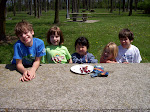
Our Family is coming up to an anniversary, actually two anniversaries, celebrated on the same day. On Thursday, November 30, 2006 the legal system of Ukraine confirmed what God had ordained from the beginning of time. Our youngest daughter became officially ours.
It was the third time that we have ever gone to court, and we have yet to go to a court where English is spoken! However, with each hearing the same picture is created: A hungry, lonely orphan loses that identity and becomes a beloved member of a family.
The best part of the court hearing is the end, when the judge has finally made their decision, and they say something to the effect of, "From this day forward, you will no longer be named ******** ******, but will now be known as ******** *********. (Sorry for the asterisk, but this is the Internet and I don't want any weirdos knowing my kids' names -- not that you're a weirdo, someone else reading this is a weirdo).
All the same, though, it is such a beautiful picture of what Christ does for us. In one spoken word from a person in authority, our daughter was no longer what she was just minutes earlier. She became a "new creation", in such a similar way that when a person becomes a Christian the old is gone and the record of the old is wiped clean. If you traveled to Ukraine and tried to find any records on our daughter's birth, under her birth name, they wouldn't be there (in theory at least...) because she is no longer that person. She is a new creation. You'd have to look under her new name.
So, we will soon be celebrating our 1 year anniversary of our youngest new creation.
In addition to that anniversary, my husband and I have the unique and dubious honor of celebrating the 1 year anniversary of having a high government official from another country arrested. (There's no cute picture to go with this anniversary).
Every adoptive family is nervous when it's court day. However, last November 30th, we were nervous in a whole new way. Our judge had agreed to hear the case only if we paid her a bribe. The short version of the story is that God provided us a way to not only accomplish the adoption, but to do so legally. Instead of simply paying the bribe, we (mostly our lawyer), co-operated with the secret police. Our lawyer was wired, the money was marked, and the court hearing happened.
As we stood there, answering the judge's questions, I pondered how odd it felt to be holding court with her having absolutely no idea what was to follow. I wondered if it was all worth it, or if it would make any difference. I even wondered if it was really fair, considering the fact that she might be bribing in order to pay someone higher up, or that she wasn't the only one extorting people, she was just the one that was getting caught.
I felt sick to my stomach when she looked me straight in the eyes, smiled at me and said, "It is in the opinion of this court that we are placing this child in very loving and capable hands."
Gulp. I'm really sorry I'm having you arrested, I thought. I felt incredibly guilty.
But then I remembered, she was only saying those things because she thought we had paid her to. There was a crime, and not only we, but our daughter, and many other families and children were the victims. In fact, weeks later an adoption facilitator told me he was pleased with our actions because in some regions the judges were so corrupt that they looked at each child as a price tag. Since no Ukrainians can afford the thousands of dollars to bribe the judge, they cannot adopt a child because the judges hold them off for the foreigners who can pay. This is in an adoption system where the costs should be minimal court fees!
We left the court room and within minutes the building was flooded with secret police. It wasn't long before their presence wasn't secret! We slipped out the door to find a paddy wagon, more police, and a ever growing crowd waiting outside. It was a start to a very long day, one which ended with us barely catching the train back to Kiev (thanks to the quick ride given to us by the police!), and spending the 12-hour train ride shaking our heads, laughing, shaking our heads, and worrying.
When all is said and done, I don't know what effect, if any, this will have on corruption. And, even within my own country I'm often confused about the mixing of church and state. But I do know that God called us to honor the laws of that country, that He provided a way for us to do so, and that I truly hope He never calls us to do something like that again.
On the plus side, when I became a follower of Christ, I never thought that it would include drinking tea or eating pizza with the secret police, driving with them, spending hours (and hours -- remember, it's a slower paced culture than ours!), and hours giving testimony to a regional "procurator" or watching our judge being driven off in a paddy wagon. That's just the thing with God. You never know where you'll end up when you follow him.
And for our daughter, she was never even aware of what was going on. Even now, she's not aware of her pictures in the paper in Ukraine or any of the hullabaloo that has risen from the ensuing court case. But years down the road, we'll be able to tell her the amazing story of her adoption and she'll be able to boast that she's probably the only kid from Ukraine who had a blessing placed on her by the Captain of the Secret Police.
With God the stories are always good.
Wednesday, November 28, 2007
Thursday, November 30, 2006

Friday, October 26, 2007
A Deserted Island

Imagine you are stranded on a desert island, and you are still a child. You have no way to feed yourself, no way to learn how things work, how to read, how to count or quantify anything. You have no idea how or why you were created. 2 or 3 times a day food appears in front of you, but you have no idea where the food came from, or that anything except that particular food you daily eat exists. Somehow you are wearing clothing, but you're not sure where that came from either. You never know how long you'll be able to wear it as sometimes it just disappears and you're left with nothing.
Occasionally the wind carries sounds to you, sounds of other children having fun, playing and laughing. You never see those children because you are stranded on this island, and those other children are just far enough away that you can only hear, not see them. There is absolutely no future, but, since you are just a child, you don't even realize that. The only thing you really know is that there is a constant ache inside you because you are completely alone.
Then one day, a ship comes to the island. Several people get off the ship, and they come to visit you. They play with you. They sing songs for you. They even go so far as to tell you that you were created for a purpose and that there is a God that loves you. Then they give you a lot of candy, some trinkets, and some socks. The candy tastes great, you like the attention, and, with winter approaching, you're glad to have some extra socks to keep your feet warm, since, obviously, there's no heat on your island.
But then the people get back on their boat and float away. That day, you learned that there was life outside the island. You realized that these people knew and lived that life. They had the means to rescue you, but it never occurred to them that they could.
So, there you are: Still stuck and still lonely. The candy, the trinkets and the socks don't seem so good now. In fact, all they really did was momentarily anesthetize your situation. In the end, you face the same future.
This image first came to my mind three years ago when we were visiting our middle daughter's orphanage in Kazakstan. She came from a city that had 4 baby houses, 6 orphanages and more street children than can be accounted for. The first day we entered her orphanage I was struck by scents (cabbage and bleach -- cooking and cleaning in the orphanage) that I recognized from my oldest daughter's orphanage several years earlier. But something felt different this time. Something was, in fact, wrong, terribly wrong.
Then I realized. I was in a building with between 100-150 babies and toddlers, and yet it was completely silent. I was surrounded by people who lived and moved, but had no being. When we finally saw a group of children, they would all just stand and look at us. There was no eye contact, no facial expressions, and certainly no playing. They would slowly walk, only when prodded to by a caregiver. This lack of life was also evidenced in our daughter, who would shake when we came near her, tense up like an iron pole if we held her, and did not make eye contact with us until weeks later, despite twice daily visits to her.
There was no hope, and these tiny little people, even though they couldn't say that, understood.
The first day we visited, our daughters group was chosen to receive a generous gift from an international ministry. A missionary and several members of her church came. They sang to the children, told them a story, and then each child was given a wrapped shoebox full of candy, small toys, soap, toothbrushes and toothpaste, and sometimes even socks.
The kids opened the boxes, ate some candy and played with the toys, and then the presenters left. I watched as the orphanage staff did exactly what I expected they would: They collected up all the boxes and put the stuff in a communal spot to be administered by them. In most orphanages you don't own anything, not your own candy, not your own clothes and certainly not your own toys, even if those things are given to you as a gift.
That was the day that I had that image of a deserted island. I, in no way, want to slam any philanthropic organizations, and I'm sure that there are situations where those shoe boxes are very useful for ministering. However, at the end of that day, all 12 of those kids, with the exception of my daughter, were still facing a lifetime of institutionalization, loneliness, illiteracy and separation from God. Yes, a little candy brightened their hour, but in the scheme of things, what did it really do, and how will they ever learn about an eternally loving Father when all they experience is someone occasionally popping in and out talking about Him?
This is all coming to mind because I am seeing advertisements everywhere for the Christmas boxes, and while I see the good that can come from them I see a major pitfall. There is such a tendency to throw money and stuff at things to solve problems. Not just within the church, but here in our culture. I see this everyday with my physically handicapped children -- expensive devices, tools, therapies and treatments, etc. Everybody wants to try to fix it with something, when God's trying to work out an even better plan. And, its much easier to do the good deed of filling a shoebox full of dispensable items than it is to sacrifice greatly and listen to what Jesus is calling us to do.
When we were in Ukraine for our last adoption, someone there told us he had a friend who liked to say, "It's time we start taking these children's pictures off our refrigerator and actually start feeding the children from our refrigerators." I loved that idea, because it just encompasses my thoughts so well. We can send our money, even make trips to visit them, but are we willing to invest our lives into theirs? Are we willing to enter into their suffering, like Christ did, and make it part of our lives?
What we found is that when we chose to do that, God made their suffering into something beautiful and, actually, victorious. He has never made it easy, only good. We've had to rearrange our lives, make a lot of sacrifices, and put in a lot more effort than donating money or giving away stuff, but the rewards have been far greater.